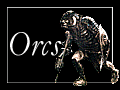
Within the deepest
pits of Utumno, in the First Age of Stars, it is said
Melkor committed his greatest blasphemy. For in that
time he captured many of the newly risen race of
Elves and took them to his dungeons, and with hideous
acts of turture he made ruined and terrible forms of
life. From these he bred a Goblin race of slaves who
were as loathsome as Elves were fair.
These were the Orcs, a
multitude brought forth in shapes twisted by pain and
hate. The only joy in these creatures was in the pain
of others, for the blood that flowed within Orcs was
both black and cold. Their stunted form was hideous;
bent, bow-legged and squat. Their arms were long and
strong as the apes of the South, and their skin was
black as wood that has been charred by flame. The
jagged fangs in their wide mouths were yellow, their
tongues red and thick, and their nostrils and faces
were broad and flat. Their eyes were crimson gashes,
like narrow slits in black iron grates behind which
coal burn.
The Orcs were fierce
warriors, for they feared more greatly their master
than any enemy; and perhaps death was preferable to
the torment of Orcish life. They were cannibals,
ruthless and terrible, and often their rending claws
and slavering fangs were gored with the bitter flesh
and the foul black blood of their own kind. Orcs were
spawned as thralls of the Master of Darkness;
therefore they were fearful of light, for it weakened
and burned them. Their eyes were night seeing, and
they were dwellers of foul pits and tunnels. In
Melkor's Utumno and in every foul dwelling in
Middle-earth they multiplied. More quickly than any
other beings of Arda their progeny came forth from
the spawning pits. At the end of the First Age of
Stars was the War of Powers in which the Valar came
to Utumno and broke it open. They bound Melkor with a
great chain, and destroyed Melkor's servants in
Utumno and with them most of the Orcs. Those who
survived were masterless and went wandering.
In the Ages that
followed were the great migration of Elves, and,
though Orcs lived in the dark places of Middle-earth,
they did not appear openly, and the Elven history
speak not of Orcs until the Fourth Age of Stars. By
this time the Orcs had grown troublesome. Out of
Angband they came in armour of steel-plate and linked
chains, and helmets of iron hoops and black leather,
beaked like hawk or vulture with steel. they carried
scimitars, poisoned daggers, arrows and broadheaded
swords. This brigand race with Wolves and Werewolves
dared in the Fourth Age of Stars to enter the realm
of Beleriand where the Sindarian Kingdom of Melian
and Thingol stood.The Grye-elves knew not what manner
of beings the Orcs were, though they did not doubt
they were evil. As these Elves did not use steel
weapons at that time, they came to the Dwarf-smiths
of Nogrod and Belegost and battered for weapons of
tempered steel. Then they slaughtered the Orcs and
drove them away.
Yet when Melkor
returned to Beleriand in the last Age of Stars, out
of the Pits of Angband the Orcs came, rank upon rank,
legion upon legion, in open war, and this was the
beginning of the Wars of Beleriand. For in the valley
of the river Gelion they were met by Thingol's
Grey-elves and Denethor's Green-elves. In this first
battle the Orcs were decimated and driven shrieking
in flight to the Blue Mountains, where they found no
refuge but only the axes of the Dwarves. None of that
Army escaped. Yet Melkor sent forth three grand
armies. The second army overran the westerrn lands of
Beleriand and besieged Falas, but the cities of the
Falathrim did not fall. So the second army of Orcs
joined the third army and mrached north to Mithrim,
where they thought they might entrap and slay the
newly arrived Noldotin Elves. But the Orcs were
little prepared for these Elves. In strength of body
the Noldor were far beyond the Darkest dreams of the
Orcs. The eyes of these Elves alone seared the flesh
of the Orcs, and the fierce light of Elves swords
drove them mad with pain and fear. So the second
Battle of Beleriand was fought against the Noldor
whom Fëanor led, and this battle was called the
Battle Under Stars, the dagor-nuin-Giliath. And
though the Noldor king Fëanor was slain, the second
and third armies of Melkor were entirely destroyed.
As the second Noldorin
army led by Fingolfin came out of the West and the
great light of the Sun mounted the Ramparts of the
Sky as with a great shout that brought fear to every
servant of Melkor. So the First Age of Sun began and
for a time the Orcs were checked by the new light of
the Sun. However, soon under cover of darkness Orcs
came in yet another grand army, more numerous than
the other three and more heavily armed, hoping to
catch the Noldor unaware. In the glorious battle the
Orc legions were slaughtered again. At this time the
siege of Angband was begun and, though Orcs at times
sallied forth in bands, for the most part they were
held within Angbands walls. Yet Melkor's might grew,
for by dark sorcery he bred more of the Orc race and
also the race of Dragons, and about them were
Balrogs, Trolls, Werewolves and monsters many and
great. When he deemed himself ready the mighty host
came into the Battle of Sudden Flame, and this broke
the siege of Angband and the Elven-lords were
defeated. From this mighty battle is counted the
reign of terror that the Orcs remembered as the Great
Years.
At that time Tol
Sirion fell and the kingdoms of Hitlum, Mithrim,
Dor-lómin and Dortonion were overrun. The Battle of
Unnumbered Tears was also fought: this was the Fifth
Battle in the Wars of Beleriand and the Elves and the
Edain were completely defeated. The evil Orc legions
of Angband then marched into Beleriand. The Falas
fell to the Orcs, as did both the cities of
Brithombar and Eglarest. The Battle of Thumbalad was
fought and Nargothrond was sacked; because of
disputes with Dwarves and the Noldor, Menegroth was
twice overrun and the Grey-elves lands were ruined.
Finally Gondoli, the Hidden Kingdom, fell. So
Melkor's victory was all but complete; his Orc
legions went wherever they wished in Beleriand. All
the Elven kingdoms were ruined; no great city stood;
and the lords and the greatest part of the Elves and
Edain were slain. Such are the tales that are joyful
to the black hearts of the Orcs.
Yet the terror of that
Age finally came to an end. For the Valar, the Maiar,
the Vanyar and the Noldor of Tirion, all came out of
the Undying Lands and the Great Battle was joined. In
it Angband was destroyed and all the mountains of the
North were broken. Beleriand with Angband fell into
the boiling sea; Melkor was cast out into the Void
forever more and his servants the Orcs were
exterminated in the North.
Still the Orcs that
survived, for in the east and the South part of the
race lay hidden in foul dens beneath dark mountains
and hills. There they bred and multiplied. Eventually
they came to Melkor's general, Sauron, offering their
services, and he became their new master. In the
Second Age of Sun they served Sauron well in the War
of Sauron and the Elves and in all his battles until
the War of the Last Alliance, when the Age ended with
the fall of Mordor and with most the Orkish race
again being exterminated.
Yet in the Third Age
of Sun, as in the Second, those Orcs hidden in dark
and evil places lived on. Masterless, the Orcs raided
and ambushed for many centuries, but made no grand
scheme of conquest until more than a thousand years
of that Age had passed, when, as a great and evil
Eye, Sauron re-appeared in the dark realm of Dol
Guldur in southern Mirkwood. As in the Second Age,
the dark destinies of Sauron and the Orcs were again
made one, and for two thousand years of the Third Age
Orcish power increased with that of their dark lord.
Their power first grew
in Mirkwood near Dol Guldur; then in the Misty
Mountains. In 1300 the Nazgûl re-appeared in Mordor
and the realm of Angmar in northern Eriador and the
Orcs flocked to them. After six hundred years of
terror, Angmar fell but the evil realm of Minas
Morgul arose in Gondor, and there again the Orcs
increased with those of the Mirkwood, the Misty
Mountains and Mordor for the next thousand years.
Yet it was said that
Sauron was not fully pleased with his Orcish soldiery
and he wished to increase their strength. And though
no tale tell of it, it was believed that Sauron
through terrible sorcery made a new breed of greater
Orcs. For, in the year 2475, those creatures called
Uruk-hai came out of Mordor and sacked Osgiliath, the
greatest city of Gondor. These Uruk-hai were Orcs
grown to the height of Men, yet straight-limbed and
strong. Though they were truly Orcs - black-skinned,
black-hooded, lynx-eyed, fanged and claw-handed -
Uruk-hai did not languish in sunlight and did not
fear it at all. So the uruk-hai could go where their
evil brethren could not, and, being larger and
stronger, they were also bolder and fiercer in
battle. Clad in black armor, often carrying straight
swords and long yew bows as well as many of the evil
and poisoned Orc weapons, the Uruk-hai were made
élite men-at-arms and most often were the high
commanders and captains of the lesser Orcs.
In the centuries that
followed, the Uruk-hai and the lesser Orcs grew still
greater in power and made alliances that they might
ruin all the kingdoms of Elves and Men that were in
the Westlands. Therefore the Orcs made treaties with
the Dunlendings, the Balchoth, the Wainriders, the
Haradrim, the Easterlings of Rhûn and the Corsairs
of Umbar to achieve their aim. The Orcs came even to
the realms of the Dwarves. In the year 1980 the realm
Moria was taken by a mighty Balrog demon. With him
there were Orcs of the Misty Mountains, who had come
out of their capital of Gundabad in great numbers to
inhabit the Dwarvish city, heaping great contempt on
the Dwarf people and slaying whosoever came near this
most ancient realm.
Yet in the North this
was to be the undoing of Orcs, for the Dwarves were
so enraged that they cared not for what cost they
would have revenge. So it was that from 2793 to 2799
there was waged a seven years' war of extermination
called the War of Dwarves and Orcs. In this war,
though dearly it cost the Dwarves, almost all the
Orcs of the Misty Mountains were hunted out and
slain, and at the East Gate of Moria the terrible
Battle of Azanulbizar was fought. The Orcs were
destroyed and the head of their Orc general, Azog,
was impaled on a stake. So it was that for a century
the Misty Mountains were cleansed of this vile race,
yet in time they returned to Gundabad and Moria.
In the year 2941 a
second great disaster befell the Orcs in the North.
After the death of the dragon Smaug, all the Orc
warriors of Gundbag came to the Dwarf-realm of Erebor
and the Battle of Five Armies was fought beneath the
Lonely Mountain. The Orcs were led by Bolg of the
North, son of Azog, and he wished to have revenge on
the Dwarves, but all he achieved was his own death
and that of all his warriors.
In the War of the
Ring, the last great conflict of the Third Age of
Sun, the Orcish legions were everywhere, as the
"Red Book of Westmarch" relates. From the
Misty Mountains and the shadows of Mirkwood the Orcs
came to war under banners both black and red.
Fearless Uruk-hai with shield and helmets carrying
the emblem of the White Hand came out of Isengard,
where the rebel Wizard Saruman ruled. In Morgul both
lesser and great Orcs were marked with a white moon
like a great skull; and under Sauron's command were
the countless Orcs of Mordor of whatever breed, who
were marked by the symbol of the Red eye. All of
these prepared for war and many others as well. They
fought numerous skirmishes and ambushes, as well as
the Battles of the Ford of Isen, The Battle of the
Hornburg, the Battle of Pelennor Fields, the Battle
under the Trees and the Battles of Dale. In these
assaults thousands on both sides fell, and, though in
many of these battles the Orcs were utterly
vanquished, it is told that Sauron held back the
greatest part of his force within Mordor until the
enemy came to the Northern gate of his realm.
All was to be resolved
in this one battle before Morannon, the Black Gate.
All the dreadful forces of Mordor were gathered there
and at Sauron's command they fell upon the army of
the Captains of the West. However at that very
moment, in the volcanic fires of Mount Doom, the One
Ring which held all Sauron's dark world in sway was
destroyed. The Black Gate and the Black Tower burst
asunder. The mightiest servants of Sauron were
consumed in fire the Dark Lord became black smoke
dispelled by a west wind, and the Orcs perished like
straw before flames. Though no doubt some Orcs
survived, they never again rose in great numbers, but
dwindled and became a minor Goblin folk possessed of
but a rumor of their ancient evil power.