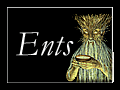
During the War of the
Ring the strange forest giants called Ents came in
battle against the Orcs and Men of Isengard. Half
Men, half trees, the Ents were fourteen feet tall,
and the eldest had lived in Middle-earth for nine
Ages of Stars and Sun.
Lord of the Ents was
Fangorn who in the common toungue was called
Treebeard. He was huge and ancient, for he belonged
to the tallest and strongest race born into the
World. Like oak or beech was the huge rough-barked
trunk of Treebeard, while his branch-like arms were
smooth and his seven-fingered hands were gnarled.
Treebeard's peculiar, almost neckless head was tall
and thick as his trunk. His brown eyes were large and
wise and seemed to glint with a green light. His wild
gray beard was like a thatch of twigs and moss. He
was made of the fiber of trees, yet he moved swiftly
on unbending legs with feet like living roots,
swaying and stretching like long-legged wading birds.
Elvish histories tell
how, when Varda, Queen of the Heavens, rekindled the
Stars the Elves awoke, the Ents also awoke in the
Great Forests of Arda. They came from the thoughts of
Yavanna, Queen of the Earth, and were her shepherds
of trees. Shepherds and guardians they proved to be,
for if roused to anger Entish wrath was terrible and
they could crush stone and steel with their hands
alone. Justly they were feared, but they were also
gentle and wise. They loved the trees and all the
Elves and guarded them from evil. At the time of
their awakening Ents could not speak, but the Elves
taught them that art, and they loved it greatly. They
delighted in learning many tongues, even the short
chirping language of Men. Dearest of all they loved
the language they had devised themselves, that none
but Ents ever mastered. It rolled deep and full from
their tongues as slow thunder or the timeless booming
of waves on forgotten shores. In the slow passing of
Entish time they formed their thoughts in unhurried
meditation, and framed them into speech as
undisturbed and rolling as the changing seasons.
Though Ents at times
had great gatherings called Entmoots, for the most
part they were a solitary folk living apart from one
another in isolated Ent houses in the great forests.
Often these were mountain caverns plentifully
supplied with spring water and surrounded by
beautiful trees. In these places they took their
meals, not solid food but clear liquid stored in
great stone jars. These were Ent-draughts and the
magical fluid glowed with gold and green light. And
in their Ent houses they took their rest, often
finding refreshment in standing beneath the crystal
coolness of a waterfall throughout the night. So the
Ents lived out their wise, almost immortal lives, and
the many races of the Earth thrived and declined
around them without troubling their greatness.
Only when the foul
Orcs came armed with weapons of steel were the Ents
roused in wrath. The dwarves too were not loved by
the Ents, for they were axe-bearers and hewers of
wood. And it is said that in the First Age of Sun the
Dwarf-warriors of Nogrod, who had sacked the
Grey-elven citadel of Menegroth, were caught by Ents
and utterly destroyed. Ents, in the years of
starlight, had been both male and female, yet in the
Ages of Sun the Entwives became enamoured of the open
lands where they might tend the lesser Olvar - the
fruit trees, shrubs, flowers, grasses and grains,
whereas the male Ents loved the trees of the forests.
So it was that the Entwives went to the open Brown
lands, where they were worshipped by the race of Men
who learned from them the art of tending the fruits
of the Earth. Yet before the Second Age of Sun, the
gardens of the Entwives were destroyed, and with the
gardens went the Entwives. Among them was the spouse
of Treebeard, Fimbrethil, who was called Wandlimb the
Lightfooted. No tale tells of their fate. Perhaps the
Entwives went to the South or East; but, wherever it
was, it was beyond the knowledge of the Ents of the
forests, who wandered in search of them for many long
years.
So, though Ents could
not die in the manner of Men, they became a dwindling
race none the less. They were never numerous, and
some were slain with steel and fire, and no new
Entings came with the departure of the Entwives. As
well, the vast forests of Eriador where many once
roamed had by the Third Age been hewn down or burnt,
so Only the Old Forest, which bordered the Shire, and
the great Entwood of Treebeard remained. By the War
of the Ring Treebeard was counted one of the three
eldest Ents who had came forth under the Stars at the
Time of Awakening. Besides Treebeard, there was
Finglas, which means "leaflock", and
Fladrif, which means "skin-bark", but the
latter two had withdrawn even from the affairs of the
Ents. Finglas had retreated in Ent fashion into the
nature of his being and had become
"treeish". He moved but little and few
could tell him from the trees. Faladrif had battled
alone against Orcs, who had captured his birch
groves, slain many of his Entings, and had wounded
him with axes. He eventually fled to live alone on
high mountain slopes.
Though only Treebeard
of the elders remained limb-lithe and active, there
were many young Ents. Throughout the Entwood there
was discontent because the Ents were being harassed
by the servants of Saruman, who inhabited neighboring
Isengard. So the Ents entered the War of the Ring,
and this was the Great March of the Ents. Rank upon
Rank of Ents marched on the stronghold of Isengard.
With them came the Huorns, the Tree-spirits whom the
Ents commanded and whose strength was nearly as great
as their own. The very walls of Isengard were torn
down and destroyed by Entish wrath and the power of
Saruman shattered. The Huorns advanced into the
battle of the Hornburg like a great forest, and the
Orc legions of Saruman was exterminated. After the
War of the Ring, the Ents again lived on peacefully
in the Entwood, yet they continued to wane, and the
Fourth Age was believed to be their last.